 A Magidome guide
What Size Geo Dome Do I Need for a Backyard Greenhouse?
A geo dome for a backyard greenhouse typically ranges from 10 to 20 feet in diameter, with your ideal size depending on how many plants you'll grow and whether you need standing room.
A geo dome for a backyard greenhouse typically ranges from 10 to 20 feet in diameter, with your ideal size depending on how many plants you’ll grow and whether you need standing room. Most home gardeners find that a 15-foot dome offers the sweet spot between usable floor space, headroom for tall plants, and manageable assembly.
How Dome Diameter Affects Growing Space
The diameter you choose determines both your floor area and your vertical clearance. Here’s how common sizes compare for backyard greenhouse use:
| Diameter | Floor Area | Center Height | Best For |
|---|---|---|---|
| 10 ft | ~79 sq ft | ~5 ft | Herbs, seedlings, compact vegetables |
| 15 ft | ~177 sq ft | ~7.5 ft | Mixed vegetables, tomatoes, small fruit trees |
| 20 ft | ~314 sq ft | ~10 ft | Full garden variety, dwarf trees, workspace |
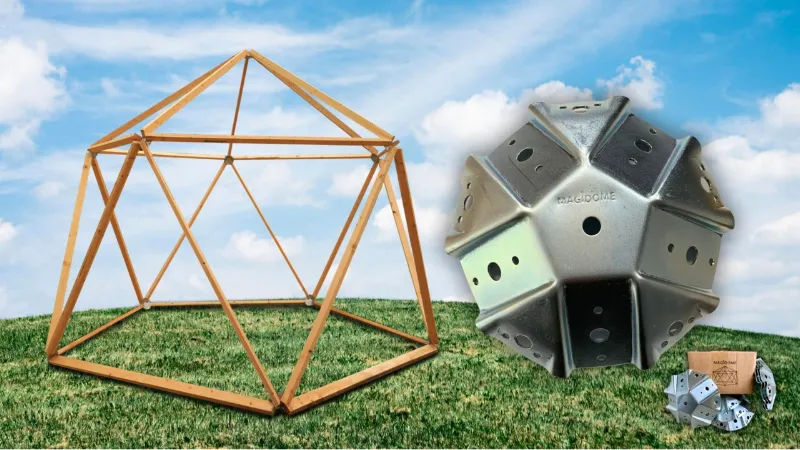
A geodome kit in the 15-foot range gives you roughly 177 square feet of floor space, which comfortably accommodates raised beds along the perimeter plus a central aisle. Remember that geodesic dome structures slope inward, so your usable planting height decreases as you move toward the walls.
Matching Dome Size to Your Plant Types
Your plant selection directly influences the size you’ll need. Compact crops like lettuce, herbs, and peppers thrive in shorter zones near the dome’s edge, while anything that climbs or grows tall requires the taller center section.
For low-growing plants (lettuce, spinach, strawberries):
- 10 to 12-foot diameter provides enough edge space
- Height at 3 feet from center is still 3 to 4 feet
- Ideal if you’re starting seeds or growing microgreens
For medium-height crops (tomatoes, cucumbers, beans on trellises):
- 15-foot diameter gives 6+ feet of height in a 6-foot radius circle
- Center pole or trellis system works well
- Most versatile size for year-round vegetable gardening
For tall or vining plants (indeterminate tomatoes, pole beans, small citrus):
- 18 to 20-foot diameter provides 8+ feet of clearance in the central zone
- Allows you to walk upright while tending plants
- Justifies the footprint if you’re serious about perennial crops
When you check the latest price on a larger geo dome kit, consider whether you’ll use the full footprint or if a mid-size option better suits your plant list.
Calculating Your Actual Space Requirements
Start by sketching your growing layout before you commit to a dome size. A practical method:
- List your plants and quantities: Write down what you want to grow and how many of each
- Assign square footage: Tomatoes need 4 sq ft each, lettuce heads need 1 sq ft, peppers need 2 to 3 sq ft
- Add aisle space: Plan for a 2-foot-wide path so you can reach everything
- Include staging or workspace: Benches, potting areas, and tool storage add 15 to 25 sq ft
If your total comes to 120 square feet, a 15-foot dome (177 sq ft usable) leaves room to expand. If you’re pushing 200 square feet, step up to an 18 or 20-foot geodesic dome connector kit to avoid cramming plants into low-clearance edges.
We find that first-time greenhouse builders often underestimate how much space pathways consume. A dome that looks spacious on paper feels tight once you add soil, pots, and the need to move a wheelbarrow or watering can.
Assembly and Site Considerations by Size
Smaller domes are faster to build and easier to site, but larger domes offer better climate stability and airflow. Here’s what changes as you scale up:
10 to 12-foot domes:
- One or two people can assemble in a weekend
- Fits in tight urban yards or side gardens
- Requires a level pad roughly 12 x 12 feet
- Geodesic dome connectors and poles are lighter and easier to handle
15 to 16-foot domes:
- Two people, one to two weekends depending on foundation prep
- Needs a 17 x 17-foot cleared area (includes guy-line anchors if used)
- Heavier components; consider a helper for lifting ridge sections
- Better thermal mass and air circulation than smaller sizes
18 to 20-foot domes:
- Plan for two to three people and extended assembly time
- Site prep is critical; uneven ground becomes obvious at this scale
- Check local zoning for accessory structure limits (many cap sheds at 200 sq ft without permits)
- Wind loading increases; guy wires or foundation anchors are often necessary
If you’re ordering a geo dome for the first time, measure your yard’s level area and confirm you have at least 2 feet of clearance beyond the dome’s radius for staking and maintenance access.
Ventilation and Climate Control Scale
Dome geometry naturally promotes air circulation, but the volume of air inside scales faster than you might expect. A 15-foot dome encloses roughly 880 cubic feet, while a 20-foot dome holds around 2,100 cubic feet.
Ventilation needs:
- Smaller domes (10 to 12 ft) heat up and cool down quickly; plan for top and base vents
- Mid-size domes (15 to 16 ft) benefit from cupola kit installations at the apex for passive hot-air escape
- Larger domes (18+ ft) may need fan-assisted ventilation in summer or if you’re in a hot climate
The more air volume you have, the more stable your temperature swings become, which is why serious growers often choose 18-foot or larger geodesic dome kits even if their plant count doesn’t strictly require it. Thermal buffering makes climate control simpler and protects sensitive crops from sudden temperature spikes.
You can grab the code for 5% off any dome size, so if you’re on the fence between two diameters, the cost difference after discount is often smaller than you’d expect.
Budget and Future-Proofing Your Choice
Dome kits scale in price roughly with surface area, but the cost per square foot often drops as you go larger. A 10-foot dome might run a certain price per square foot, while a 20-foot dome’s per-square-foot cost is lower because hub and connector counts don’t double linearly.
When to size up:
- You plan to garden year-round and want workspace inside
- You’re growing perennials or shrubs that will expand over multiple seasons
- You want to add aquaponics, a potting bench, or storage shelves
- Your property allows it and you’d rather build once than upgrade later
When to size down:
- You’re experimenting with greenhouse growing for the first time
- Your yard or HOA limits structure size
- You prefer intensive, compact gardening (vertical towers, hydroponic racks)
- You want the shortest possible assembly and lowest material cost
Most geodesic dome kits are modular, so if you start with a 12-foot model and later want more space, you can often reuse the geodesic dome connectors in a larger build or add the smaller dome as a dedicated seedling house.
Our Sizing Recommendation for Most Backyard Gardeners
If you grow a typical mix of vegetables and want room to work comfortably, a 15 to 16-foot diameter geo dome hits the best balance. You’ll have enough center height to walk upright, enough floor area for raised beds and an aisle, and enough air volume to keep temperatures stable without complex climate systems.
Start by mapping your plant list and measuring your yard’s buildable area, then compare those numbers to the floor-area table above. When in doubt, round up one size; the extra space almost always gets used for staging flats, overwintering pots, or simply moving around without bumping into tomato cages. Check the current pricing and our exclusive code to see how the size options fit your budget, and remember that a properly sized dome will serve you for many growing seasons.
Questions
What is the most popular geo dome size for home greenhouses?
The 15-foot diameter dome is the most popular choice for backyard greenhouses because it provides around 177 square feet of floor space and 7 to 8 feet of center height, which accommodates most vegetable gardens and allows you to walk upright in the middle.
Can I use a 10-foot dome for tomatoes and peppers?
Yes, but you'll need to position tall plants like indeterminate tomatoes in the very center where headroom is highest. A 10-foot dome works better for determinate (bush) tomato varieties and compact pepper plants that stay under 4 feet.
Do I need a building permit for a 20-foot geodesic dome greenhouse?
Permit requirements vary by location, but many municipalities require permits for structures over 120 to 200 square feet or those with permanent foundations. A 20-foot dome is around 314 square feet, so check your local zoning rules before you buy.
How much headroom do I lose at the edges of a geodome kit?
In a typical 15-foot dome with 7.5 feet of center height, you'll have roughly 4 to 5 feet of clearance at a point 5 feet from the center and only 2 to 3 feet near the base. Plan low-growing crops or storage along the perimeter.
Can I connect two smaller domes instead of buying one large dome?
Yes, some growers connect two domes with a short tunnel to create separate climate zones (one for cool-season crops, one for heat-loving plants). You'll need compatible geodesic dome connectors and careful planning for the junction, but it offers flexibility.
What dome size do I need if I want to include a potting bench inside?
Add at least 20 to 30 square feet to your plant-space calculation for a workbench and aisle access. A 15-foot dome can fit a small bench, but an 18 or 20-foot dome gives you a dedicated workspace without crowding your growing area.
Products in this guide
Shopping at Magidome? See the discount code
5% OFF All Orders
More in this series
How Long Does a Geodesic Dome Last Outdoors? Durability and Weather Resistance Explained17 Sep 20266 minIs a Cupola Kit Worth Adding to a Magidome Dome?17 Sep 20264 minDo Geodesic Dome Connectors Work with Standard PVC Pipe?17 Sep 20266 minGeodome Kit vs. Buying Connectors Separately: Which Option Saves You More?17 Sep 20264 minHow to Build a Geodesic Dome: Step-by-Step Assembly Guide for Beginners17 Sep 20265 min