 A Open Sheet Music guide
How to Learn Beethoven’s Waldstein Sonata Op. 53: A Practice Plan
A staged plan to learn Beethoven's Waldstein Sonata Op. 53, how to tell if you are ready, and what to know about Open Sheet Music's PDF score.
To learn Beethoven’s Waldstein Sonata Op. 53, work section by section through its three parts (the Allegro con brio, the short Introduzione and the Rondo), practice the hardest passages slowly and in isolation, and only then join them into full run-throughs. There is no honest fixed answer to how many months that takes, because it depends on your technique, your practice time and your goal, so plan in stages and judge progress by what you can play, not by the calendar. You can find the current code on our Open Sheet Music discount code page.
Getting the score
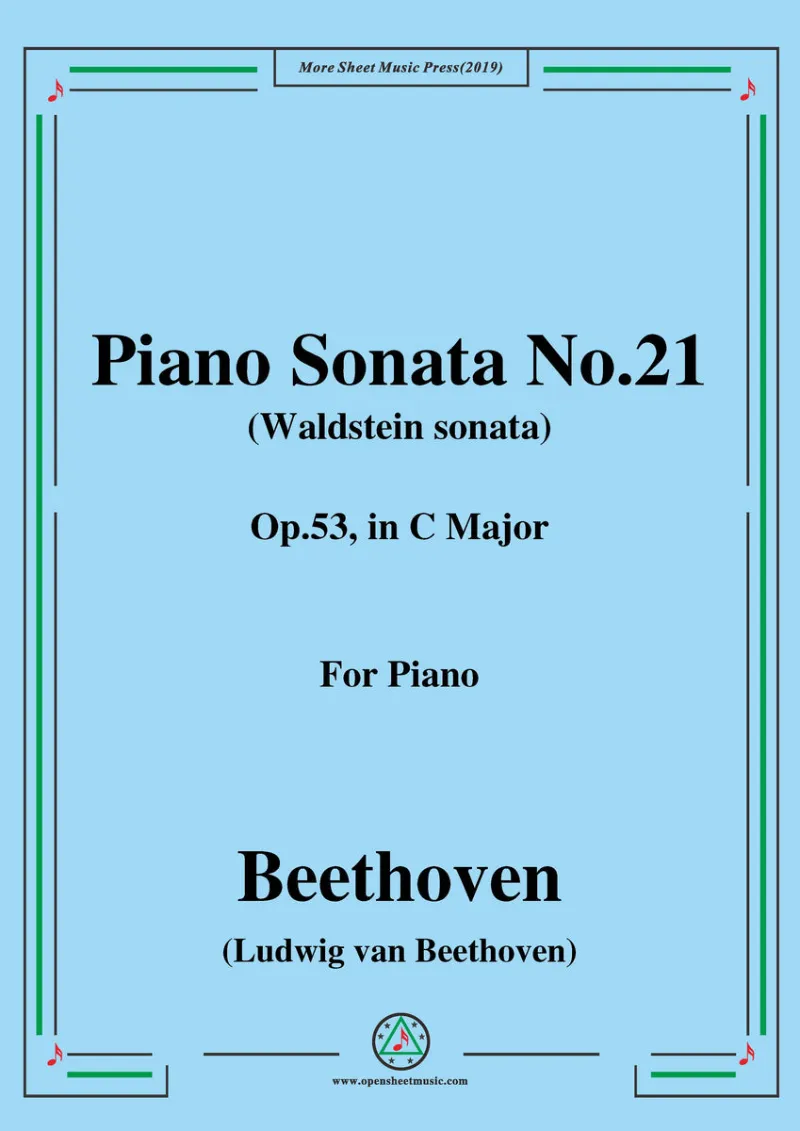
Open Sheet Music sells the Beethoven Piano Sonata No. 21, Waldstein Sonata, Op. 53 in C major as a digital PDF for piano. The listing names the publisher as More Sheet Music Press. Because it is a PDF, you can print extra practice copies and write fingerings, pedal marks and breathing points straight onto the paper, which is how you will use it in the plan below.
A few things to know before you buy:
- Digital purchases are final. The store’s refund policy says digital purchases cannot be exchanged, refunded or cancelled.
- Defective files are replaced. If a file is defective or does not match the listing, you have 15 days to report it by email, and the store offers a new download.
- Membership pricing. The store sells monthly, quarterly and annual memberships that lower the price of every product, and it says you can cancel or change the plan at any time. It only pays off if you buy several pieces.
Map the sonata before you practice
Read through the whole score at the piano, slowly, before you commit to fingerings. Mark the structure on your printout:
| Part | Marking | What to plan for |
|---|---|---|
| First movement | Allegro con brio | Fast repeated chords at the opening, long runs, and keeping a steady pulse across a large structure |
| Introduzione | Adagio molto | Slow, quiet playing that leads without a break into the finale; tone and pedaling matter more than speed |
| Rondo | Allegretto moderato, ending Prestissimo | A long singing theme over moving accompaniment, the famous octave glissandi, and a very fast coda |
Circle every passage that you cannot play at a slow tempo on first reading. That list becomes your practice plan, and it will be different for every pianist.
A practice plan in four stages
Stage 1: notes and fingering
Choose one section at a time. Settle on a fingering, write it in, and play hands separately until the notes are secure. Keep the tempo slow enough that you never stop to search for a note. Changing fingering later costs more time than taking care now.
Stage 2: the hard passages on their own
Take each circled passage out of context and practice it daily in short, focused sessions. Use a metronome and raise the tempo only when the passage is clean at the current setting. For the repeated chords and the glissandi, work for the smallest motion that does the job, and stop at the first sign of strain in the hand, wrist or forearm. Speed built on tension does not hold up in a full run-through.
Stage 3: joining sections
Link two sections, then three, until you can play a whole movement at a slower tempo without stopping. Practice the transitions on their own, especially the move from the Introduzione into the Rondo, since that join is easy to neglect.
Stage 4: tempo, shape and memory
Bring each movement toward your target tempo in small steps. Record yourself and listen back with the score open, marking anything that sounds uneven or unclear. If you plan to play from memory, start memorizing section by section during stages 1 and 2 rather than leaving it to the end.
How to tell if you are ready to start it
Instead of asking how long the Waldstein takes, ask whether you can already do what it asks. Before you begin, check that you can:
- play fast repeated chords evenly without the forearm locking up;
- keep a melody clearly above a busy accompaniment in the same hand;
- sustain concentration through a long, multi-section work;
- practice daily for long enough to make steady progress on a large piece.
If several of those are not there yet, a teacher can suggest shorter pieces that build them first. If you are working without a teacher, record your stage 2 sessions and compare them week to week; that recording is a better guide to your progress than any timeline.
Open Sheet Music’s catalog has other works by Beethoven if you want to explore his writing alongside this sonata. If you cannot find a piece, the store invites you to email [email protected].
Questions
How long does it take to learn the Waldstein Sonata?
There is no reliable fixed answer. It depends on your technique, how much you practice and whether you are aiming for a run-through or a performance. Plan in stages and measure progress by what you can play.
What are the movements of the Waldstein Sonata Op. 53?
The first movement is Allegro con brio. It is followed by a short Introduzione, Adagio molto, which leads straight into the Rondo, Allegretto moderato, ending Prestissimo.
What format is Open Sheet Music's Waldstein score?
It is a digital PDF for piano, published by More Sheet Music Press according to the listing, so you can print practice copies and mark them up.
Can I get a refund on a digital sheet music purchase?
No. Open Sheet Music says digital purchases are final. If a file is defective or does not match the listing, report it by email within 15 days and the store offers a new download.
What is the hardest part of the Waldstein to practice?
That depends on the player, which is why you should circle every passage you cannot play slowly on first reading. The repeated chords, the octave glissandi and the Prestissimo coda need focused, separate practice.
Products in this guide
Shopping at Open Sheet Music? See the discount code
15% OFF All Orders
More in this series
 Why Hallelujah Piano Arrangements Vary: Finding the Right Version for Your Skill Level3 Sep 20263 min
 Mozart Piano Sonata No. 11 (K. 331) Sheet Music: What You Get at Open Sheet Music3 Sep 20263 min
 What Makes Paganini Caprice No. 24 So Difficult for Violinists?3 Sep 20264 min
 Dvorak Symphony No. 8 vs. Beethoven Symphony No. 1: Which Orchestral Score Should You Conduct First?3 Sep 20264 min
 How to Learn Chopin Etude Op. 10 No. 12: Practice Tips for the Revolutionary Etude3 Sep 20264 min