 A Flash Fish Tech guide
FlashFish E200 vs A201: Which 200W Power Station Is Right for You?
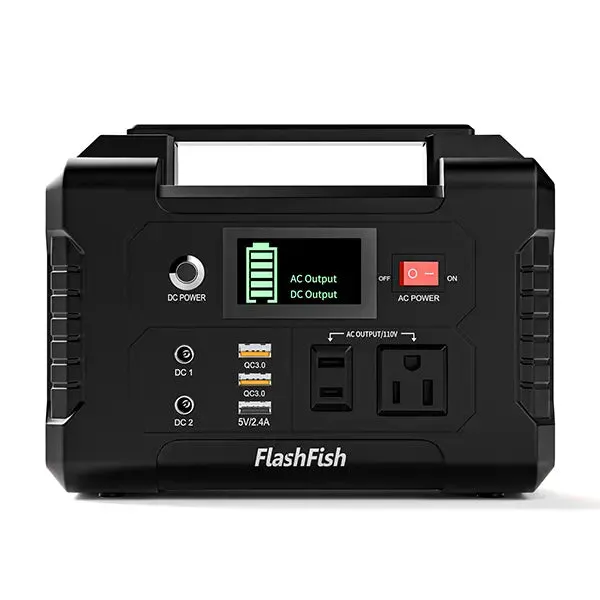
FlashFish E200 vs A201: both are 200W, but the A201 stores more energy, uses pure sine wave AC and is lighter, while the E200 uses modified sine wave.
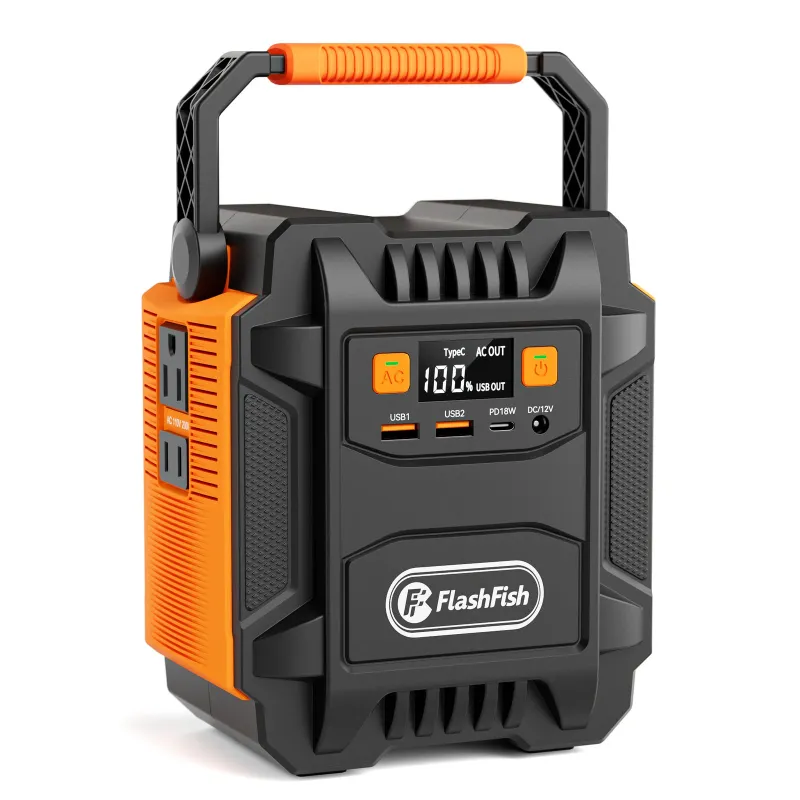
The FlashFish E200 and A201 are both 200W portable power stations, and the A201 is the one with more battery (172.8Wh against 151Wh), a pure sine wave AC output, a USB-C port, a lighter body and a 2-year warranty. The E200 uses a modified sine wave, which FlashFish says you should check your devices can handle, and its product page names CPAP machines among the devices it can power. You can find the current code on our Flash Fish Tech discount code page.
What Separates the E200 and A201
Figures from the FlashFish product pages:
| Spec | FlashFish E200 | FlashFish A201 |
|---|---|---|
| Battery | 151Wh, lithium-ion 18650 | 172.8Wh, lithium-ion |
| AC output | 200W continuous, 400W peak, modified sine wave | 200W rated, 400W surge, pure sine wave |
| USB | 2 x QC 3.0 (18W) and 1 x 5V/2.4A USB-A | USB-C PD 18W and USB-A ports |
| DC output | 2 x 12V/10A, 120W total (kit page) | 12V/10A max |
| Solar input | 11 to 24V, max 40W | 18 to 24V |
| Weight | about 1.85kg (4.08 lb) | 1.7kg |
| Cycle life listed | more than 800 | more than 800 |
| Warranty | 1 year | 2 years |
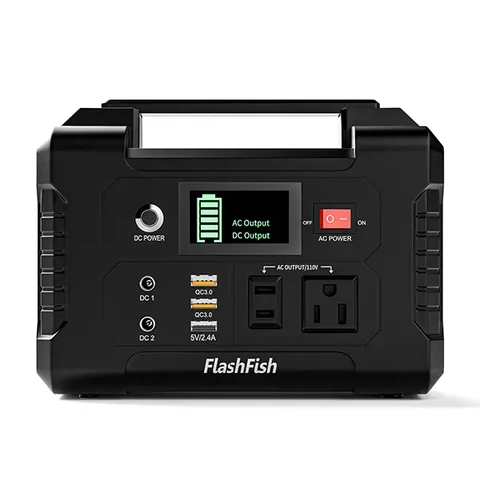
The names can be confusing, because “200W” describes both. In the FlashFish range, the FlashFish E200 and the FlashFish A201 are two different 200W models, not two versions of the same one.
Battery Capacity and Runtime
Watt-hours (Wh) tell you how much energy each station stores. The A201 holds 172.8Wh, about 22Wh more than the E200’s 151Wh, so it runs the same device for longer.
FlashFish gives a formula for the E200 on its product page: AC runtime is 151Wh x 0.9 divided by your device’s watts, and DC or USB runtime is 151Wh x 0.95 divided by your device’s watts. Its own example is a 20W device on AC, which works out at about 6.8 hours. Using the same approach for the A201 gives a rough estimate of 172.8Wh x 0.9 divided by the device’s watts, but FlashFish does not publish that formula for the A201, so treat it as an estimate. FlashFish also notes that real runtime is lower than the ideal figure and varies with the device, temperature and battery condition.
AC Output: Modified vs Pure Sine Wave
This is the biggest practical difference. The A201 has a pure sine wave inverter, which FlashFish says provides a clean, stable current like a home wall outlet. The E200 has a modified sine wave output. FlashFish asks buyers to confirm a device’s voltage, connector, running power, startup power and modified sine wave compatibility before connecting it, and says the E200 is not intended for long-term AC motor loads such as refrigerators or compressors.
Phone and laptop chargers may run on either waveform, but some devices with motors, sensitive electronics or certain power supplies are designed for pure sine wave power. If you are unsure, check the device’s manual or ask its maker. For CPAP use, FlashFish recommends running the machine from the E200’s 12V DC output through a DC converter from your CPAP supplier, with the heater or humidifier off.
Ports, Charging and Solar
- Wall charging: the A201 lists 6 hours with its 15V/2A adapter. The E200 uses a 15V/2.4A adapter; FlashFish does not list a full charge time on the E200 product page.
- Car charging: both can be charged from a car.
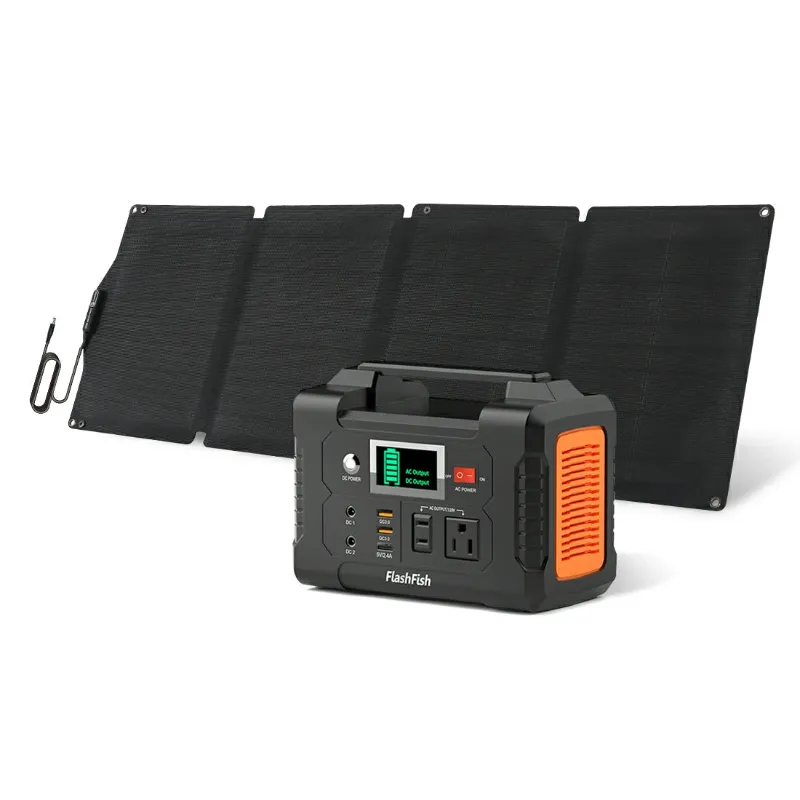
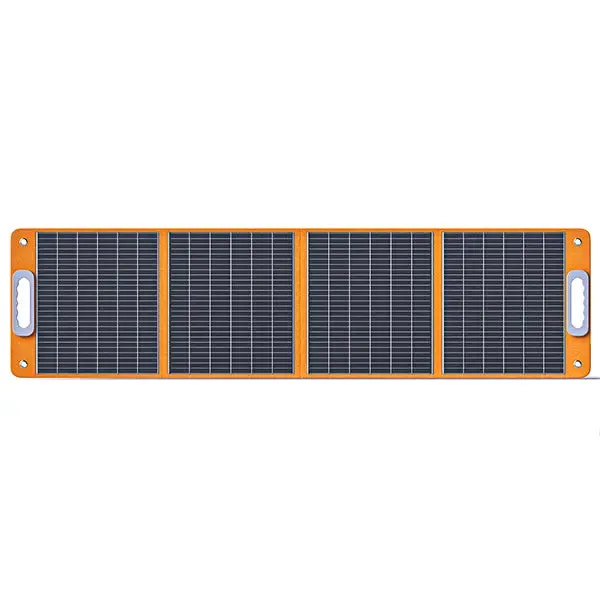
- Solar: the E200’s solar and DC input is limited to 40W, so even a larger panel will not charge it faster than that. FlashFish sells an E200 kit with a 60W SP60 panel. The A201 accepts 18 to 24V solar input and FlashFish pairs it with a 60W panel.
If you already own the FlashFish TSP100 100W solar panel, it outputs 18V, so it suits both stations’ input voltage ranges, but each station will only draw what its input allows.
Which One to Pick
Choose the A201 if you want the extra capacity, pure sine wave AC for a wider range of devices, a USB-C port, the lighter body and the longer warranty.
Choose the E200 if the devices you plan to run work on modified sine wave or DC, or if you want the E200 and solar panel kit.
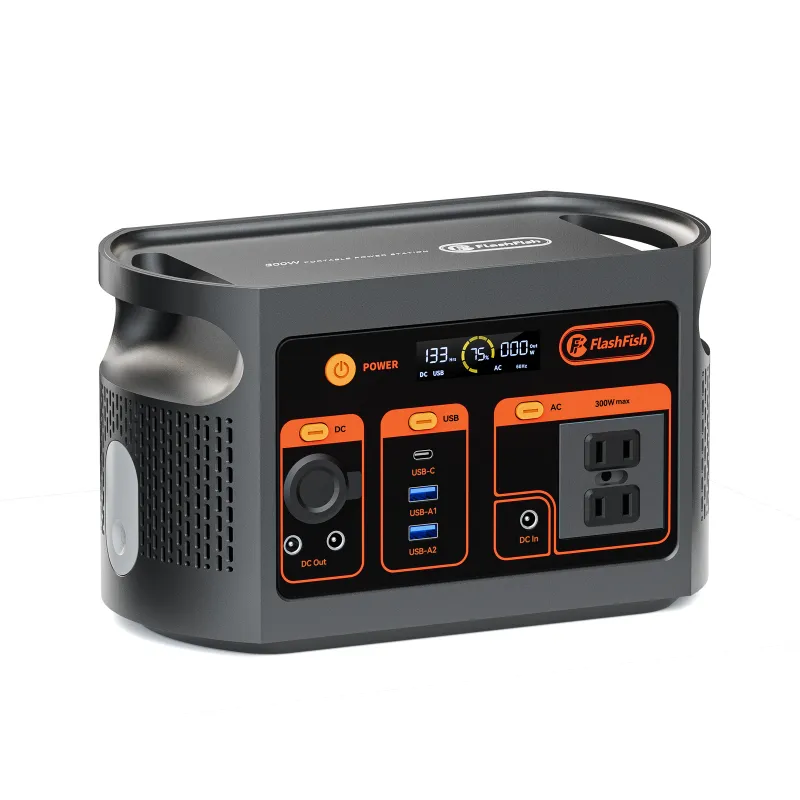
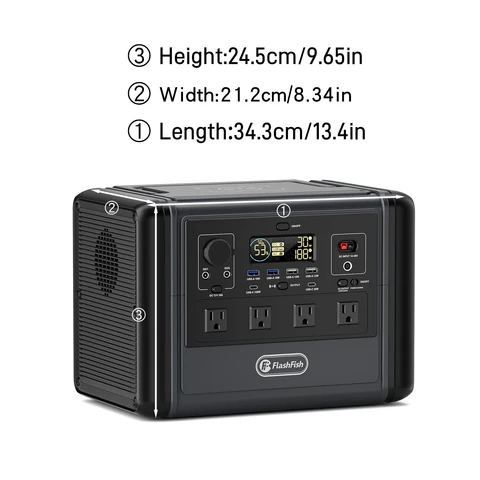
If neither is enough, FlashFish sells the E103, which it lists at 179.2Wh with a LiFePO4 battery and 300W pure sine wave output, and the T1200S, which it lists at 768Wh and 1200W for heavier loads like coffee makers and power tools. Before choosing, add up the watts of the devices you want to run at the same time and compare that with each station’s rated output.
Questions
What is the difference between the FlashFish E200 and A201?
Both are 200W stations. FlashFish lists the A201 at 172.8Wh with pure sine wave AC, a USB-C PD port, 1.7kg and a 2-year warranty, and the E200 at 151Wh with modified sine wave AC, about 1.85kg and a 1-year warranty.
Which FlashFish 200W station lasts longer?
The A201, because it stores 172.8Wh against the E200's 151Wh. Runtime still depends on your device's power draw, the output you use and the temperature.
Can the FlashFish E200 run a CPAP machine?
The E200 product page lists CPAP machines among the devices it can power. FlashFish recommends using the 12V DC output with a DC converter from your CPAP supplier and turning off the heater or humidifier. Ask your CPAP supplier or doctor whether this suits your machine.
How fast can solar charge the FlashFish E200?
The E200's solar and DC input is limited to 40W at 11 to 24V, so a larger panel will not charge it faster than 40W. Sunlight, angle, shade and temperature lower real charging power.
Which FlashFish model has a pure sine wave inverter?
Among these two, the A201. FlashFish also lists pure sine wave output for the E103 and T1200S. The E200 uses a modified sine wave.
Products in this guide
 Shopping at Flash Fish Tech? See the discount code
10% OFF All Orders
More in this series
 What Can the FlashFish T1200S 1200W Power Station Run?18 Aug 20263 min
 FlashFish 100W Solar Panel Charging Time: How Long Each Power Station Takes18 Aug 20263 minFlashFish E200 CPAP Use: Can It Run a CPAP Machine Overnight?18 Aug 20263 minFlashFish E200 vs E103: Which Power Station Has Better Battery Life?18 Aug 20263 min
 How to Choose the Right FlashFish Power Station for Camping18 Aug 20263 min