 A 7Artisans guide
How to Get Sharp Macro Shots With the 7Artisans 60mm F/2.8 2X Lens
Get sharp macro shots with the 7Artisans 60mm f/2.8 2X lens: steady support, a 2X focusing workflow, focus stacking and how to find your aperture range.
To get sharp macro shots with the 7Artisans 60mm f/2.8 2X lens, hold the camera still on a support, set the magnification first and then focus by moving the camera rather than the ring, and use your camera’s focus aids to confirm the plane of focus before you press the shutter. This is a manual focus, full-frame lens that magnifies subjects up to twice life size and focuses as close as 0.17m, so small movements show up in every frame. Below we explain what the lens is, how to set it up, and how to work with its very thin zone of focus. For the current code, see our 7Artisans codes and deals.
What the 7Artisans 60mm 2X macro is
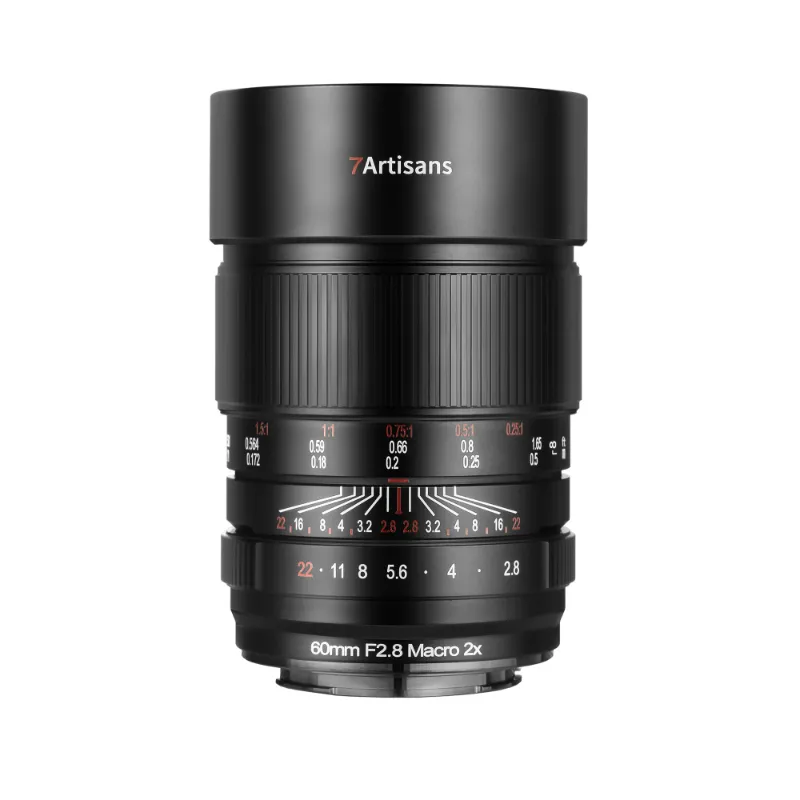
The 7Artisans 60mm f/2.8 2X ultra-macro lens is listed on the 7Artisans store with these features:
- Manual focus, made for full-frame mirrorless cameras, in Sony E, Nikon Z and Canon EOS-R mounts.
- 2X magnification, meaning a subject can fill the sensor at twice its real size.
- 0.17m minimum focusing distance, measured from the sensor plane, so you can get close to small subjects.
- An all-metal body, which 7Artisans says adds stability and durability.
- 2 ED elements and 2 high-refractive elements, which the brand says suppress chromatic aberration and reduce edge distortion.
7Artisans also pitches the f/2.8 aperture for portraits, so the lens is not only for close-ups. The store page does not list the weight, filter thread or aperture blade count for this model, so check the box or ask 7Artisans if you need those before buying a filter or ring light.
Set up for sharpness
At 2X, the zone that is in focus is thin and any movement of the camera moves it. A steady setup does more for sharpness than any setting.
- Support the camera. A tripod is the first choice for still subjects. A focusing rail on top of it lets you move the camera forwards and back in small steps without moving the tripod legs.
- Remove touch from the shutter. Use the camera’s self-timer, a remote release or a phone app, so pressing the button does not shake the frame.
- Use electronic shutter if your camera has one. It removes the movement of the mechanical shutter. Watch for banding under artificial light and switch back if you see it.
- Light the subject. More light lets you stop down and keep a faster shutter speed. Diffuse the light with a sheet of white paper or a softbox so shiny subjects do not show hot spots.
A focusing workflow that works at 2X
With a manual macro lens, the focus ring also sets the magnification. That changes how you focus.
- Choose the magnification first. Turn the ring to the reproduction size you want, for example full 2X for the eye of an insect, or less for a whole flower.
- Move the camera to focus. Slide the camera on the rail, or lean in and out if you are handholding, until the detail you want snaps into focus. This keeps your framing and size fixed.
- Use focus aids. Turn on focus peaking and magnified live view in your camera menu. Peaking highlights the edges that are in focus, which is the quickest way to see where the thin plane of focus is sitting.
- Pick the point that matters. On a living subject, that is the eye. On a product, it is the logo or texture the viewer will look at first.
- Check the result at 100%. Zoom into the frame on the screen before you move on. A shot that looks sharp at full view can miss by a fraction.
If you need more of the subject sharp than one frame allows, shoot a focus stack: take a series of frames, moving the camera a small step forwards between each, then merge them in stacking software. Keep the light and settings identical across the series so the frames blend cleanly.
Aperture choice, and other 7Artisans macro options
f/2.8 gives the thinnest focus and the softest background, which works for an artistic shot of a petal edge. Stopping down deepens the zone of focus, but past a certain point diffraction softens fine detail. The point where that starts depends on your camera’s sensor, so shoot the same subject at a range of apertures and compare them at 100% on your own body. That gives you your working range for this lens.
7Artisans sells other close-up lenses if the 60mm 2X is not the right fit:
| Lens | What the store lists | Who it suits |
|---|---|---|
| 60mm f/2.8 2X (full frame) | 2X magnification, 0.17m minimum focus, manual focus | Full-frame shooters who want twice life size |
| 60mm f/2.8 Mark II (APS-C) | 1x macro, inner focusing so the length never changes, 9-blade aperture, 49mm filters | APS-C shooters who want life-size macro |
| 120mm T2.9 Macro 2X (full frame) | 2X macro, 82mm filter options | Shooters who want more distance from the subject |
| 65mm T2.9 Macro Cine (full frame) | Cine version with a T-stop | Video shooters |
7Artisans dispatches orders within 48 hours, offers free shipping on orders of $150 or more, and accepts returns of unused items in original packaging within 14 days of receipt.
Questions
How do I get sharp photos with the 7Artisans 60mm 2X macro lens?
Put the camera on a tripod, set the magnification on the focus ring first, then move the camera forwards or back to focus. Use focus peaking, a self-timer or remote release, and check each shot at 100%.
What is the minimum focusing distance of the 7Artisans 60mm f/2.8 2X?
The 7Artisans store lists 0.17m.
Is the 7Artisans 60mm 2X macro autofocus?
No. It is a manual focus lens for full-frame mirrorless cameras in Sony E, Nikon Z and Canon EOS-R mounts.
Which aperture should I use for macro with this lens?
f/2.8 gives the thinnest focus. Stopping down adds depth until diffraction starts to soften detail, which depends on your sensor. Shoot one subject at a range of apertures and compare at 100% to find your range.
What is the difference between the 60mm 2X and the 60mm Mark II?
The 60mm 2X is a full-frame lens with 2X magnification. The 60mm Mark II is an APS-C 1x macro lens with inner focusing and a 9-blade aperture.
Products in this guide
Shopping at 7Artisans? See the discount code
5% OFF All Orders
More in this series
 7Artisans Pancake Lens 35mm F/5.6: How Thin Is It and Does Image Quality Suffer?10 Aug 20264 min
 What Mount Fits the 7Artisans 14mm F/2.8 Lens? Sony E, Canon RF, Nikon Z, L10 Aug 20263 min
 7Artisans 50mm F/1.8 Autofocus Lens for Sony E: What to Know10 Aug 20264 min
 Are 7Artisans Lenses Sharp Enough for Professional Photography?10 Aug 20263 min7Artisans 35mm F/1.2 Mark II vs F/1.4: Which Aperture Should You Buy?10 Aug 20263 min