 A VisoOne Eyewear guide
What to Look for When Buying Blue Light Glasses Online
A five point checklist for buying blue light glasses online, using VisoOne listings: size code, bridge, material, lens claims and returns.
When buying blue light glasses online, check five things before you pay: the size code against a pair that already fits you, the bridge width, the frame material, what the seller actually states about the lens, and the return terms if the fit is wrong. VisoOne publishes these on its product pages and policy pages, so below we use its listings to show where to find each one and what to do when a detail is missing. For the current code, see our VisoOne Eyewear codes and deals.
1. The size code
This is the number to check first on any glasses listing. VisoOne shows it as, for example, 54□19-145: lens width, bridge width and temple (arm) length, in millimeters. If a pair you already wear has a similar code printed inside an arm, compare the two.
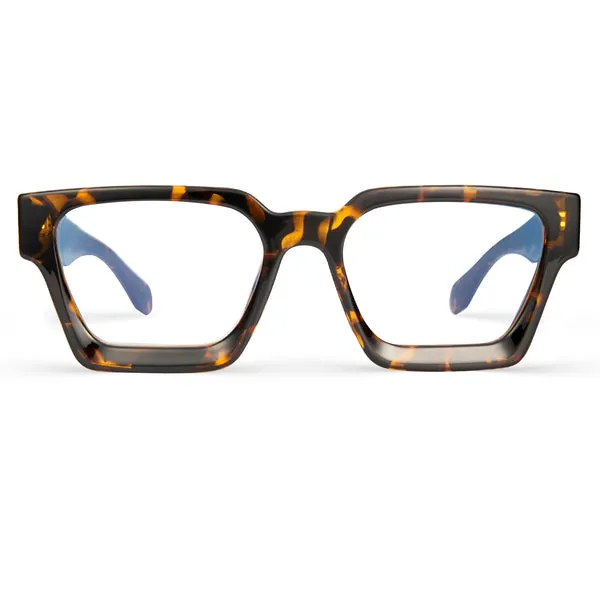
VisoOne also sorts frames into sizes by adding the lens width to half the bridge width. Under 57 mm is XS, 57 to 60 mm is S, 60 to 63 mm is M, over 63 mm up to 66 mm is L, and over 66 mm is XL. The VisoOne River blue light glasses, at 54□19-145, are listed as Large; the Sanford, at 50□24-145, is Medium. VisoOne asks you to allow for a 2 mm difference in its measurements.
VisoOne’s fit guide adds a quick check for width: the frame should be slightly wider than your face, with no more than a finger width between the arm and your temple. If you own glasses that fit, measure from hinge screw to hinge screw for your ideal frame width.
2. Bridge width and temple length
The bridge is where the glasses rest on your nose, and it decides whether they sit level or slide. VisoOne’s guide says a lower bridge number suits close-set eyes and a higher one suits wide-set eyes. Its frames range from a 16 mm bridge on Harvard to 24 mm on Sanford, so the difference between models is real.
Temple length decides whether the arms reach comfortably behind your ears. VisoOne’s frames list 143 to 145 mm on the models we looked at, and its guide notes that temple length varies less between frames than the other measurements.
3. Frame material and build
A good listing names the material. VisoOne does: River, Cougar and Harvard are TR90, Sanford is acetate and metal with a top bar and wire core temple pin, and Montana 900 is PC. If a listing from any seller does not name the material, ask before you buy, because the material affects weight, feel and how the frame holds up.
Look at the hinge and arm details too. VisoOne highlights the wire core and hinges on River and the wire core on Sanford as the parts that add strength.
4. What the seller states about the lens
VisoOne lists the lens type as Blue Light on each frame, and the Sanford page lists anti blue light, anti eye fatigue, UV protection and clear vision as features. The pages do not give a filtering percentage or a lab report. When any seller makes lens claims without numbers, treat them as marketing and decide on fit and frame instead.
VisoOne’s blog explains that yellow or amber tinted lenses block more blue light but change color perception, while clear lenses block less and keep colors natural. Check the product photos for tint, and if color accuracy matters for your work, ask the seller which lens a frame uses.
These glasses are sold as non-prescription. If you need vision correction or have eye discomfort, see an optometrist or eye doctor first; VisoOne’s own blog gives the same advice.
5. Returns, warranty and shipping
Buying glasses online means you cannot try them on first, so the return terms carry real weight. VisoOne offers a 30 day fit and use guarantee on website orders: a one-time same value replacement or a refund within 30 days of fulfilment if the glasses do not fit well or are not wearable because of their material. It also gives a warranty against clear defects in material or workmanship, listed as 1 year on product pages and 2 years in the FAQ, so confirm the term for your order. Both apply only to orders from VisoOne’s own site, not to pairs bought on other platforms.
For shipping, VisoOne’s FAQ lists free standard shipping to the US with an estimated 7 to 14 days, or express in 3 to 5 days for an extra US$3. Its FAQ also explains where to enter a discount code at checkout on desktop and mobile.
A practical way to use all this: pick two frames whose size codes sit within a couple of millimeters of a pair you already like, order the one whose shape you prefer, and use the 30 day guarantee if the fit is off.
Questions
What should I look for when buying blue light glasses online?
The size code compared with a pair that fits, the bridge width, the frame material, what the seller actually states about the lens, and the return terms if the fit is wrong.
What does 54□19-145 mean on a glasses listing?
Lens width 54 mm, bridge width 19 mm and temple length 145 mm. VisoOne uses this format on every product page.
How much blue light do VisoOne lenses filter?
VisoOne's product pages do not give a filtering percentage, so we do not state one. They list the lens type as Blue Light.
What if VisoOne glasses do not fit when they arrive?
Website orders have a 30 day fit and use guarantee, allowing a one-time same value replacement or a refund within 30 days of fulfilment.
How long does VisoOne shipping take to the US?
VisoOne's FAQ lists free standard shipping estimated at 7 to 14 days, or express shipping at 3 to 5 days for an extra US$3.
Products in this guide
Shopping at VisoOne Eyewear? See the discount code
20% OFF All Orders
More in this series
 Are Square Eyeglasses Flattering on Round Faces?8 Sep 20263 min
 How Long Do Blue Light Glasses Last? Care Tips for Extended Wear8 Sep 20263 minTR90 vs Acetate Glasses: Comparing VisoOne’s Black Square Frames8 Sep 20263 minVisoOne Blue Light Blocking Glasses: What They Can and Cannot Do8 Sep 20263 minHow to Choose the Right Blue Light Glasses for Your Face Shape8 Sep 20263 min